
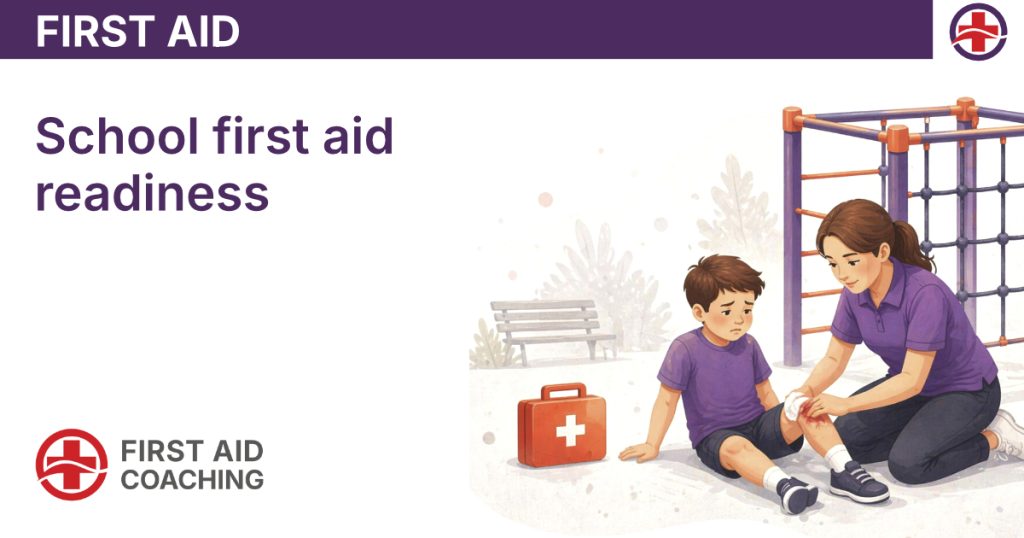
Schools operate in environments where responsibility for student welfare is constant. From minor incidents to serious emergencies, staff are expected to respond quickly, calmly and effectively. This expectation is not only practical, but also part of a school’s duty of care.
First aid training for schools should therefore focus on real-world application. It needs to be accessible, relevant to the school environment, and delivered in a way that builds staff confidence and supports compliance with current guidance.
The dedicated schools training page provides a clear overview of how training can be structured for both staff and students, with flexibility depending on each school’s needs.
Why first aid training matters for school staff
Teachers, SNAs and school staff are often the first responders when an incident occurs. While policies and procedures are important, the ability to act confidently in the moment depends on practical training.
Effective school-based training supports:
- Immediate response to injuries and medical emergencies
- Clear decision-making under pressure
- Confidence in using CPR and AED equipment
- Alignment with HSE guidance and school policies
For many schools, the priority is ensuring that designated staff are appropriately trained, particularly those with responsibility for student welfare. This is where structured programmes such as Basic First Aid or First Aid Response (FAR) become relevant.
Practical delivery tailored to school environments
One of the main barriers schools face is logistics. Timetables, staff availability and group sizes vary significantly. Training must adapt to these constraints.
A practical approach to delivery includes:
- On-site training at the school to reduce disruption
- Flexible scheduling across single or multiple days
- Scalable group sizes, from small staff groups to large cohorts
- Multiple instructors where required for larger groups
This flexibility allows schools to plan training without impacting teaching time unnecessarily, while still ensuring staff receive adequate, hands-on experience.
Addressing common questions from schools
- Cost and budgeting: Schools often need clarity on cost before committing. In most cases, pricing is flexible and based on group size, course type and scheduling. This allows training providers to work within a school’s budget rather than applying fixed rates.
- Group size and capacity: Training can be delivered to both small and large groups. Whether a school needs training for a core staff team or a full staff cohort, sessions can be structured accordingly.
- Certification: Staff typically receive recognised certification following completion.
This may include:- A provider-issued certificate (commonly valid for two years)
- Optional additional certification, such as CPR and AED awareness
Schools can choose the level of certification depending on their internal requirements and roles.
- Scheduling during the school year: Training can be arranged around the school timetable.
Many schools opt for:- In-service days
- After-school sessions
- Split sessions across multiple days
This ensures minimal disruption while maintaining training quality.
- Extending training to students: While staff training is the priority, many schools also choose to include students, particularly Transition Year groups.
Student training focuses on:- Basic first aid awareness
- Confidence in emergency situations
- Age-appropriate, practical skills
Combining staff and student training can be an efficient approach, both logistically and financially, while reinforcing a culture of safety across the school.
A practical approach to compliance and confidence
First aid training should not be viewed as a one-off requirement. It is part of a broader responsibility to maintain a safe and prepared school environment.
A structured, practical programme supports:
- Ongoing compliance with safety expectations
- Staff confidence in handling real-life scenarios
- Clear procedures in emergency situations
Schools that invest in this approach are better positioned to respond effectively when incidents occur.
Planning your school’s training
Each school has different requirements, and training should reflect this. The most effective approach is to review:
- The number of staff requiring training
- The appropriate course level (Basic First Aid or FAR)
- Scheduling options within the school calendar
From there, a tailored plan can be developed that fits both operational needs and budget. For a detailed overview of options and to discuss what would work best for your school, refer to the school’s training page and submit an enquiry.
A clear, early enquiry allows time to plan sessions, secure preferred dates and ensure training is in place when it is needed most.