Why is first aid training a valuable addition to Transition Year?
Transition Year gives students space to learn in a different way. It is a year designed to support personal development, practical learning and preparation for life beyond school. For that reason, schools often look for activities that are useful, engaging and relevant to students’ everyday lives.
First aid training meets all three requirements.
- it gives students practical experience,
- encourages them to take responsibility and
- helps them understand what to do when someone is injured or becomes seriously unwell.
Unlike many classroom topics, it is knowledge they may need to use without warning.
A skill students can use anywhere
First aid is not limited to a particular career or workplace.
A student may need to help someone during sport, at home, while travelling, at a part-time job or in the local community. Even knowing how to contact emergency services clearly, recognise when someone needs urgent help or begin CPR can make a meaningful difference.
This gives first aid a particular value within Transition Year. It connects learning with situations students can immediately understand.
Rather than preparing for an exam, they are preparing for real life.
Building confidence without creating fear
Young people can sometimes feel uncertain about emergencies because they do not know what is expected of them.
Practical training helps replace that uncertainty with a clear process. Students learn how to assess a situation, protect their own safety, call for help and provide appropriate assistance while waiting for emergency services.
The aim is not to make students feel responsible for managing every emergency. It is to help them understand that calm, simple actions can be useful.
That knowledge can increase confidence while reinforcing the importance of acting within their level of training.
Supporting responsibility and decision-making
First aid education also develops wider skills that align well with the aims of Transition Year.
Students must listen, observe, make decisions and communicate clearly. They learn that responding to an incident is not only about technical knowledge, but also about staying calm, working with others and recognising when additional help is needed.
These skills have value far beyond first aid.
They support independence, teamwork and personal responsibility, all of which are important as students move towards further education, employment and adult life.
Making learning practical and memorable
Transition Year students often respond well to activities where they can participate rather than simply listen.
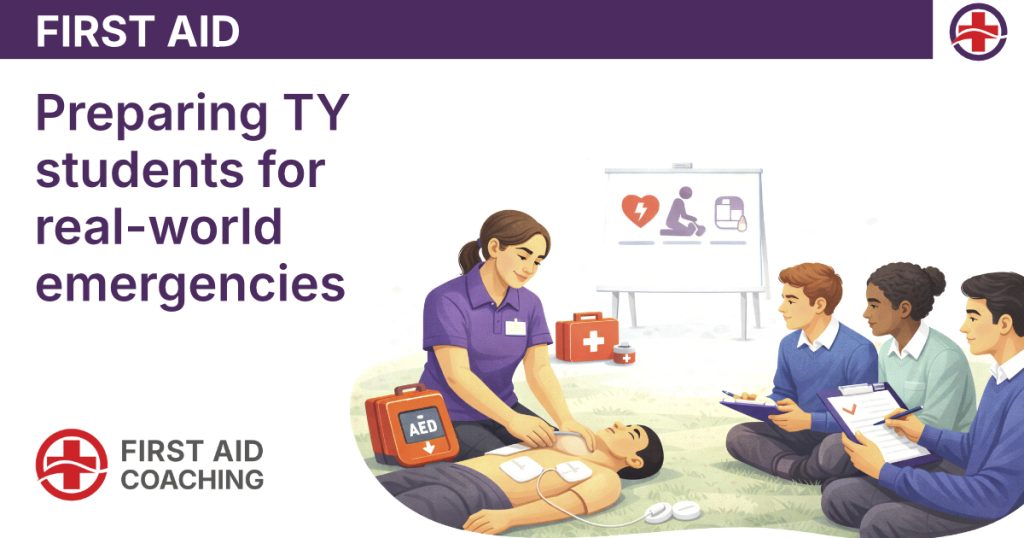
First aid training naturally lends itself to practical learning. Demonstrations, CPR practice and emergency scenarios allow students to apply what they have learned in a controlled environment.
This makes the session more engaging and helps reinforce key information.
It also gives students the opportunity to ask questions they may not raise in a more formal classroom setting.
More than a CPR class
CPR is an important part of the training, but the TY programme goes much further than a short CPR lesson.
During the full training day, students also learn how to respond to a range of situations they may encounter at school, at home, during sport or in the community. These include bleeding, choking, fractures, anaphylaxis, asthma attacks, seizures, diabetes-related emergencies, concussion, poisoning and the safe management of an emergency scene.
The emphasis throughout is on practical participation. Students work through hands-on scenarios and learn how to assess what is happening, protect their own safety, contact emergency services and provide appropriate assistance while help is on the way.
Training is delivered in person by instructors with frontline experience in areas such as paramedicine, nursing and the emergency services. At the end of the day, each student receives a certificate that can be included in their Transition Year portfolio as evidence of completing a full day of first aid training.
Creating a wider culture of safety
Introducing first aid during Transition Year can also support the broader school community.
Students become more aware of safety, emergency procedures and the importance of seeking help quickly. They may also be more likely to recognise risks and respond appropriately during school activities, sports or trips.
While trained adults remain responsible for managing emergencies in school, informed students can contribute to a more safety-conscious environment.
The value extends beyond the individual participant.
Relevant to many future pathways
First aid training is particularly useful for students considering careers in healthcare, childcare, education, sport, hospitality, construction, community work or emergency services.
However, its relevance is not limited to those sectors.
Most workplaces value people who can remain calm, communicate clearly and respond responsibly during an incident. First aid awareness therefore supports general employability as well as specific career interests.
It can also introduce students to areas of work they may not previously have considered.
A useful addition to a balanced TY programme
A strong Transition Year programme usually includes a mix of academic development, personal growth, career exploration and practical experience.
First aid training fits naturally within that mix.
It is educational without being overly classroom-based. It is serious, but highly interactive. Most importantly, it gives students knowledge with a clear purpose.
For schools, it offers an activity that supports student development while also reinforcing safety and emergency preparedness.
Planning first aid training for your TY group
Schools may wish to consider first aid training as part of a dedicated life-skills module, a wellbeing programme, a careers initiative or a broader school safety programme.
The most suitable format will depend on the number of students, the available timetable and the level of training required.
First Aid Coaching provides practical Transition Year first aid training for schools, with programmes designed to suit different group sizes and school schedules.
To review the training options, request further information or book a session, visit the Transition Year First Aid training page and complete the